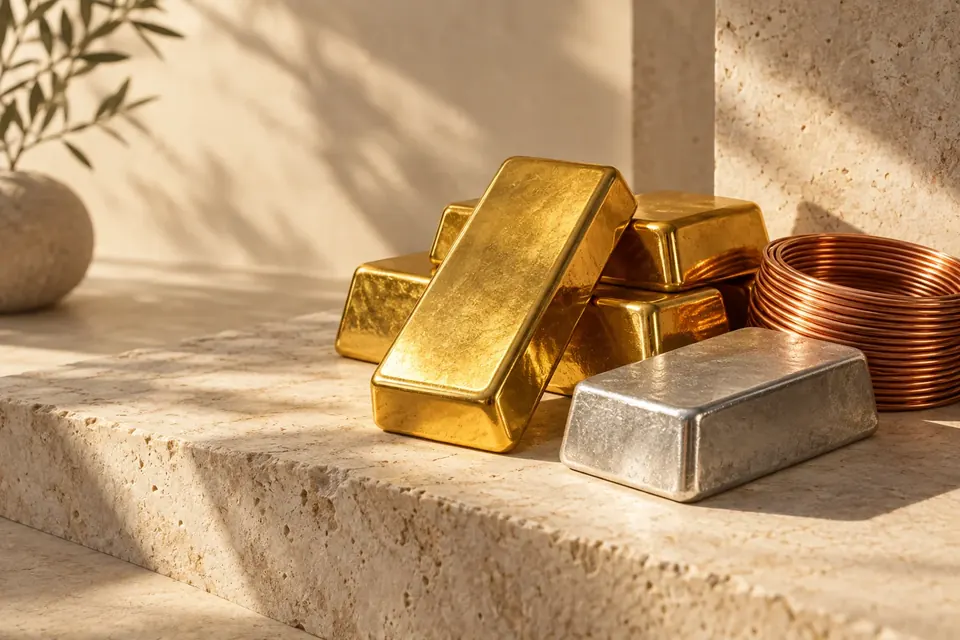
A useful metal price answers five questions: which material, how much of it, in which currency, at what time, and under which trading conditions. A number without those labels is difficult to compare and easy to misread.
Start with the series
A spot quote, a futures settlement and a monthly average describe different things. Spot refers to a near-term transaction under a market's conventions. A futures price refers to a contract with its own delivery month. A monthly average summarises a period; it is not an executable offer today. price-chart.com keeps monthly history separate from spot observations.
Make the units match
Precious metals commonly use troy ounces. Base metals commonly use metric tonnes. Converting both values into grams makes their mass basis comparable, but it does not make different grades or products interchangeable. Our unit selector changes only the arithmetic mass basis.
Ask what the buyer actually pays
A small retail bar has production, distribution and inventory costs. A dealer's selling price can include a premium above a benchmark, while a buyback offer can fall below it. Shipping and tax may be extra. Compare the total delivered price and the fine-metal content, rather than the headline premium alone. Our guide to spot prices and bullion premiums shows how to calculate it.
Check the clock and the currency
A source timestamp tells you when the observation belongs; the time our worker fetched it is a different fact. Currency conversion adds another date, as our guide to exchange rates and metal prices explains. A reference exchange rate is not necessarily the rate your bank or dealer will offer. price-chart.com discloses the FX date and uses the latest available reference rate for conversions of historical charts; those conversions are not historical local-currency returns.
A quick comparison checklist
- Use the same metal, grade and fine weight.
- Match the observation period and series type.
- Use one currency and include the exchange spread.
- Add delivery, fabrication charges and applicable tax.
- Confirm whether the quote is a buy price, sell price or reference.
Start with the metals overview, then open an instrument to inspect its source and historical table.
Test yourself. Check what you learned with the commodity basics challenge quiz: 5 quick questions, each with a short explanation.
Sources & further reading
Educational reference. How we create and review our content.