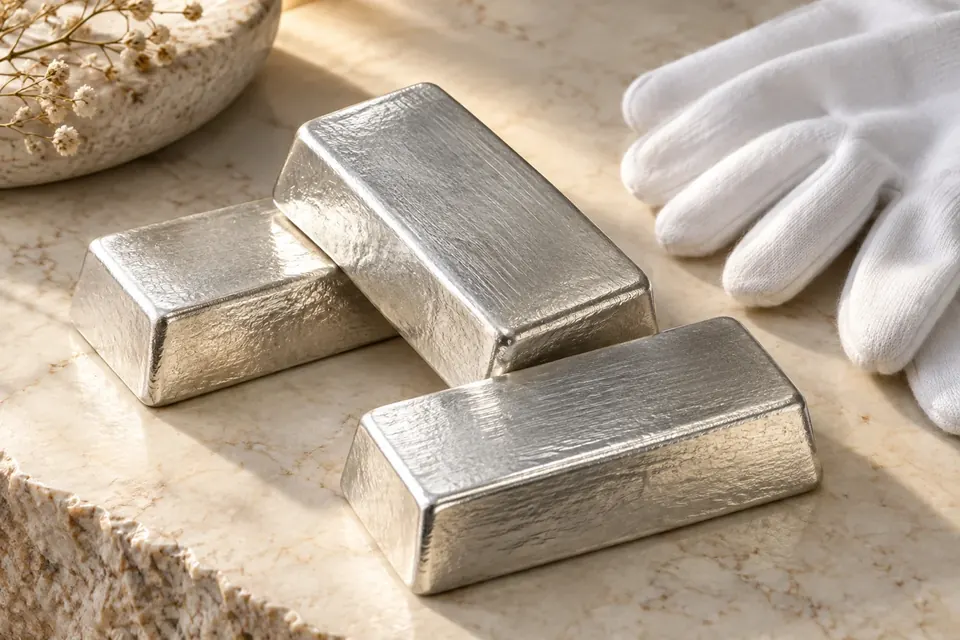

A benchmark price describes a defined wholesale reference. A retail coin is a finished product. Minting, quality control, packaging, stock financing and distribution all affect what a seller charges for that product.
Calculate a comparable premium
First find the product's fine-metal content. Multiply that by the reference price in the matching unit. Subtract this contained-metal value from the quoted product price to find the premium amount. Divide the premium amount by the contained-metal value and multiply by 100 to express it as a percentage. The bullion premium calculator runs these steps for you, including delivery and tax.
For example, a product containing one fine troy ounce priced at USD 105 against a hypothetical USD 100 reference has a 5% quoted premium. If delivery adds USD 8, the delivered premium becomes 13%, before any tax. The starting numbers are illustrative, not silver or gold prices.
Compare the exit as well as the entry
A dealer's buyback offer can be different from its selling price. Ask for both quotes for the same product at approximately the same time. A product with a low purchase premium may still have a wide resale spread, especially where local demand or authenticity verification is a concern.
Smaller is not always cheaper per gram
Fixed fabrication and packaging costs are spread across fewer grams in small bars. Larger products may have lower unit costs but offer less flexibility when selling part of a holding. Weight alone is not a sufficient reason to select a product.
Use the calculator for the arithmetic metal component. Keep premiums, taxes, delivery, custody and insurance as separate costs. A reference calculation is not an offer to buy or sell.
Test yourself. Check what you learned with the metal value and weight quiz: 5 quick questions, each with a short explanation.
Sources & further reading
Educational reference. How we create and review our content.